Picture this: someone in the room lights up and says, “I finally copped my grail – DS, OG colorway, ’85.” The whole group reacts. You smile and nod.
But you have no idea what just happened.
This glossary is the decoder ring. Whether you’re just stepping into sneaker culture explained for beginners or you’ve been buying kicks for years and still hit a term you don’t recognize, these are the sneaker terms every collector should know – sorted by category, explained like a friend, not a textbook.
Condition Terms: How Clean Is the Shoe?
In sneaker collecting, condition is everything. These terms define the state of a shoe and directly affect its value on the resale market. Learn these first – they’ll change how you read any listing.
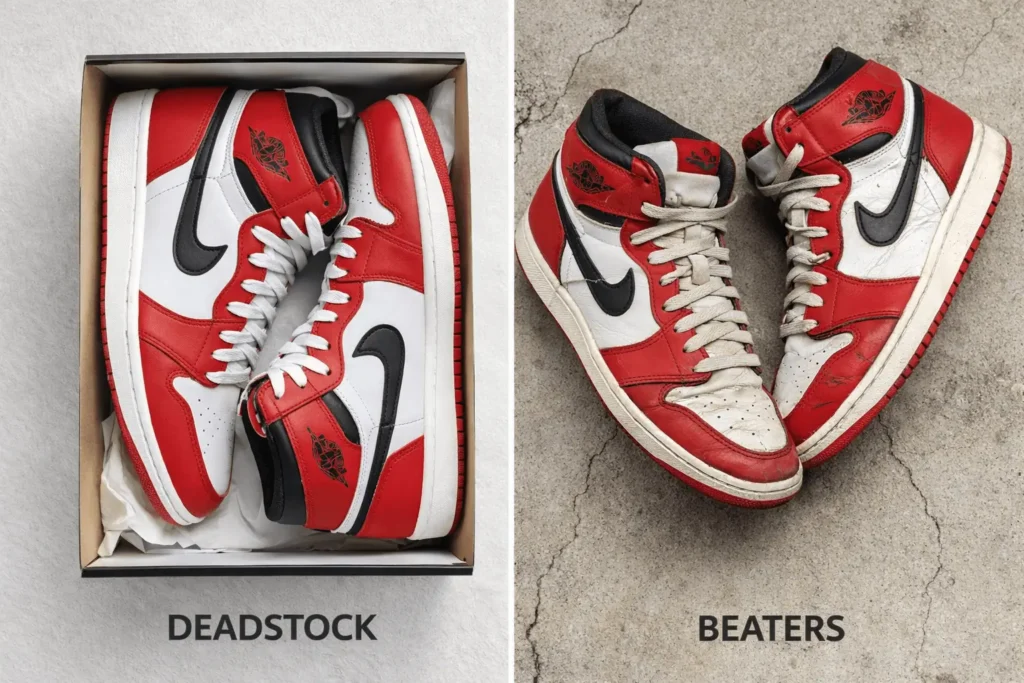
DS (Deadstock)
Brand new. Unworn. In original box with original laces, tags, and packaging intact. DS is the gold standard of sneaker condition1. The term originally came from retail, where “deadstock” meant unsold merchandise sitting on shelves – inventory that never moved. In sneaker culture, it was repurposed to mean a shoe that has never been worn and is still in its original state. A DS pair from 1985 is as close to time travel as collecting gets2.
One thing to note: the box matters. Serious DS collectors expect the original box to be present and undamaged, not just the shoes.
VNDS (Very Near Deadstock)
Tried on once or twice – maybe briefly worn indoors, on carpet, for a few minutes. Shows almost no signs of wear. VNDS is the honest label for a pair that came close to DS but crossed the threshold3. On resale platforms, VNDS typically commands a slight discount compared to true DS because the condition window was opened, even barely.
UNDS (Undeadstock)
A pair that was DS – and then got worn. UNDS is a transparency label in listings and trades. It tells you: this shoe was DS, and it isn’t anymore. If you see UNDS in a listing title priced near DS, that’s worth questioning. The reason to use this term rather than just “worn” is precision – it signals the shoe once met DS standards before being used.
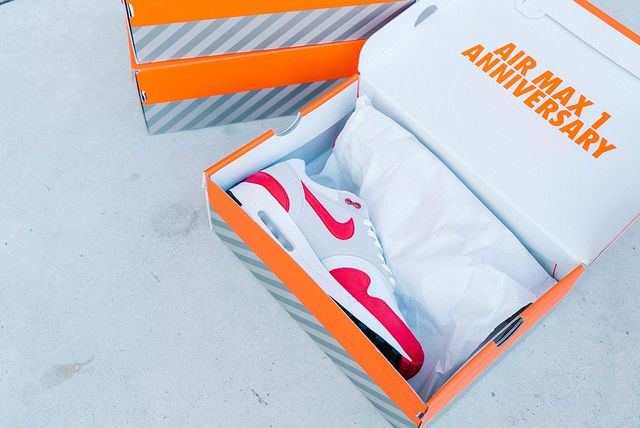
BNIB (Brand New In Box)
Essentially synonymous with DS, but specifically emphasizes that the original box is present and intact4. For older or rarer models, box condition significantly impacts value. A DS pair without its box is still DS – but BNIB collectors pay a premium for the complete, untouched package.
Beaters
Shoes worn regularly, through everything. Rain, mud, summer heat, everyday errands. Beaters are kept to be lived in, not displayed5. Most serious collectors maintain a rotation of beaters alongside their preserved pairs. There’s no shame in beaters – they’re shoes doing what shoes are supposed to do.
Crease
The wrinkles that form on the toebox of a sneaker from normal wear6. Creases are natural, but collectors try hard to prevent them – using crease protectors inside the shoe or stuffing boxes with tissue paper. Heavy creasing drops a shoe’s condition grade significantly on resale and is one of the first things a serious buyer checks in listing photos.
Rarity and Release Terms: How Exclusive Is It?
This is where sneaker culture builds its own hierarchy. These terms define how rare a shoe is, how it was distributed, and what level of access was required to get it.
Grail
The one. The pair a particular collector wants above everything else7. This is the most emotionally loaded term in the glossary – and it’s entirely personal. One person’s grail might be a $30,000 game-worn Air Jordan 13 from the Last Dance. Another person’s grail might be a retro colorway that sold out the day they turned 18, and they’ve been chasing it since. There’s no objective grail. There’s just yours.
Understanding why sneakerheads collect shoes really starts here: every serious collector has a story about the one that got away, the size that slipped through, the pair they passed on and regretted. A grail is part aspiration and part unfinished business.
OG (Original)
From the first release. If a shoe is OG, it came out when the model first launched – not a re-release, not a retro, not an updated version8. An OG pair of Air Jordan 1s from 1985 is categorically different from a 2023 retro of the same colorway, even if they look nearly identical at a glance.
Retro
A re-release of an older silhouette or colorway, manufactured years after the original. Most Jordan models at retail today are retros – the Air Jordan 1 “Chicago” has been re-released multiple times across decades. Retros give wider audiences access to iconic designs, but OG pairs almost always command a higher premium.
Colorway
The specific combination of colors on a sneaker9. Not just “red and black” – each colorway has a name. “Bred” (black and red). “Chicago” (red, white, black). “University Blue.” Colorways are a core part of a shoe’s identity; the same model in two different colorways can have completely different cultural significance and resale value. For a deep look at which ones matter most, see the most iconic Jordan colorways of all time.
General Release (GR)
A sneaker available to the public at wide retail with no restrictions – no raffle, no exclusive access, walk in and buy it. Most everyday sneakers are GR. The accessibility is the point.
Quickstrike (QS)
A Nike-specific limited release tier. Quickstrikes are available only at select boutique retailers, in limited quantities, sometimes with regional early access10. More exclusive than a General Release, less so than Hyperstrike. QS releases often sell through quickly, generating secondary market demand.
Hyperstrike (HS)
The rarest release tier in Nike’s system. Produced in extremely limited quantities – often reserved for friends and family of employees, artists, or celebrities11. Hyperstrikes rarely appear at retail at all. When they surface on the secondary market, prices reflect their scarcity.
PE (Player Exclusive)
Sneakers designed specifically for an individual athlete, typically in a unique colorway or with custom details not available to the public12. PEs are made for one person – one team’s colors, one player’s number in the heel. Because PEs are singular by design, they carry significant collector interest on the rare occasions they reach the secondary market.
Collab
Short for collaboration. A collab is a shoe co-designed through a brand partnership – with an artist, designer, celebrity, or another brand13. Off-White x Nike, Travis Scott x Jordan Brand, New Balance x Stone Island – these are collabs. They almost always result in limited releases with high demand, because two distinct aesthetics colliding in a single silhouette is exactly what collectors chase.
Raffle
A lottery-based system for distributing high-demand limited releases14. Stores or apps collect entries; winners are selected at random and given the chance to purchase. Raffles exist to manage extreme demand and prevent automated bots from clearing inventory in seconds. Enter, and you might cop – or you might take an L.
Culture and Community Terms: The Language of the Room
Once you know what you’re buying and how exclusive it is, here’s how the community actually talks about all of it. These are the words you’ll hear in stores, on forums, in comment sections, and in every conversation where sneakers come up.
Cop
To buy. The essential verb of sneaker culture. “I copped the Jordan 1 Chicago.” “Did you manage to cop?” “Where did you cop those?” Simple, constant, and irreplaceable in the lexicon.
Drop
A release event – the specific moment (or window) when a sneaker becomes available for purchase15. “The drop is Saturday at 10am.” Drops come with anticipation, preparation, and sometimes a queue around the block or a SNKRS app battle.
Heat
Highly coveted, visually striking, or culturally significant sneakers16. “Those are heat” is one of the highest compliments a pair can receive. Heat is partly objective (rare and desirable) and partly subjective – but when a room of sneakerheads agrees, it’s heat.
Hypebeast
Someone who buys sneakers and streetwear based purely on what’s trending or what carries the highest status value, rather than personal taste or genuine cultural knowledge17. The term carries a slightly pejorative edge within collector circles – implying someone chasing hype rather than having conviction. Every collector has an opinion on where the line is. Most draw it just above wherever they are.
On Ice
Keeping a pair in pristine, unworn condition – stored and preserved rather than worn18. “I’ve had these on ice since 2003.” A pair on ice is deliberately protected: stored away from light and humidity, box intact, tissue paper in place. The goal is that it stays DS indefinitely.
Icy sole
A translucent or clear outsole that has not yellowed over time19. Clear rubber soles oxidize as they age, turning from crystal clear to dingy yellow. An icy sole signals the shoe was stored well and remains close to original condition. Highly prized on older pairs.
L (Loss)
Taking an L means failing to cop a pair you tried for. Lost the raffle. Missed the drop window. Sold out at checkout. “Took an L on the SNKRS app.” L and W have traveled far from their sports origins into everyday sneaker culture – both get heaviest use on release days.
W (Win)
Successfully copping. “Got the W on the Chicago 1s.” Brief, satisfied, done. The opposite of an L, and the goal of every drop.
LPU (Latest Pick Up)
The most recently acquired pair in a collection20. LPU is a community ritual – post your new pickup, show the group what you got, participate in the collective appreciation of fresh kicks. It’s a small act that makes collecting feel shared rather than solitary.
Quick Reference: All the Terms at a Glance
| Term | Category | One-Line Definition |
|---|---|---|
| DS | Condition | Brand new, unworn, original box |
| VNDS | Condition | Nearly new, tried on briefly |
| UNDS | Condition | Was DS, now worn |
| BNIB | Condition | Brand new in original box |
| Beaters | Condition | Worn daily regardless of conditions |
| Crease | Condition | Wrinkles on toebox from wear |
| Grail | Rarity | The one pair you want most |
| OG | Rarity | Original first release, not a retro |
| Retro | Rarity | Re-release of an older model |
| Colorway | General | Specific color combination of a shoe |
| GR | Release | General Release – available at wide retail |
| QS | Release | Quickstrike – limited to select retailers |
| HS | Release | Hyperstrike – rarest Nike release tier |
| PE | Rarity | Player Exclusive – made for one athlete |
| Collab | Release | Brand partnership shoe |
| Raffle | Release | Lottery-based purchase system |
| Cop | Culture | To buy |
| Drop | Culture | A scheduled release event |
| Heat | Culture | Highly coveted or striking sneakers |
| Hypebeast | Culture | Buys based on hype, not personal taste |
| On Ice | Culture | Keeping a pair preserved and unworn |
| Icy sole | Culture | Clear, non-yellowed outsole |
| L | Culture | Failing to cop |
| W | Culture | Successfully copping |
| LPU | Culture | Latest Pick Up – newest acquisition |
FAQ: Quick Answers
What does DS mean for sneakers?
DS stands for Deadstock – brand new, unworn, in original box. It’s the gold standard condition in sneaker collecting, borrowed from retail terminology for unsold shelf inventory.
What is a grail in sneaker culture?
A grail is the one specific pair a collector wants more than anything else. It’s completely personal – it can be a $20,000 rarity or a $200 retro a collector missed years ago. Every serious collector has one.
What is the difference between OG and retro?
OG refers to the original first release of a model or colorway. A retro is a re-release produced years after the original. Most Jordans sold at retail today are retros.
What does “cop” mean in sneaker culture?
Cop means to buy. “Did you cop the new drop?” = “Did you buy the new release?”
Are PE (Player Exclusive) sneakers ever available for sale?
Occasionally. PEs sometimes surface on the secondary market if the original recipient sells them, or in rare cases where brands release very small quantities publicly. By definition they weren’t meant to be publicly available – which is why they command high prices when they appear.
Now You’re Fluent
The next time someone says they copped a DS OG grail in the Chicago colorway, you know exactly what happened. A collector found the one pair they’d been chasing, brand new in box, in the original 1985 colorway. That’s a very good day in the culture.
Sneaker culture has its own vocabulary because it’s a culture worth taking seriously – full of history, community, obsession, and genuine passion. At Dunkare, we live in that same world: where what you wear carries meaning, and knowing the language is the first step to truly belonging in it.
- The Sole Supplier – Sneaker glossary and condition terms, thesolesupplier.co.uk
- SneakerHistory – Deadstock definition and origin, sneakerhistory.com
- LiveProxies – Sneaker condition glossary, liveproxies.io
- SneakerHistory – BNIB sneaker term, sneakerhistory.com
- Asphalt Gold – Sneaker slang glossary, asphaltgold.com
- Retailed.io – Sneaker condition and crease definition, retailed.io
- SoleSavy – What is a grail sneaker, solesavy.com
- Heritage Auctions – Sneaker terminology guide, ha.com
- JD Sports – Sneaker lingo explained, jdsports.com
- The Sole Supplier – Quickstrike and release tiers, thesolesupplier.co.uk
- Heritage Auctions – Hyperstrike definition, ha.com
- Highsnobiety – Player Exclusive PE sneakers explained, highsnobiety.com
- Retailed.io – Collaboration term in sneakers, retailed.io
- Retailed.io – Raffle definition and process, retailed.io
- The Established – Sneaker culture vocabulary, theestablished.com
- JD Sports – Heat and sneaker slang, jdsports.com
- The Sole Supplier – Hypebeast definition, thesolesupplier.co.uk
- Snipes USA – Sneaker culture slang guide, snipesusa.com
- Snipes USA – Icy sole definition, snipesusa.com
- Asphalt Gold – LPU and collector community terms, asphaltgold.com