They banned one. Paid the fines on another — and turned every dollar into one of the greatest ads in history. One sold for $176,000 because it appeared in a cartoon. One was worn the night Michael Jordan dunked so hard he shattered a backboard in Italy.
These are not just colorways. They are chapters in the most consequential sports story ever told.
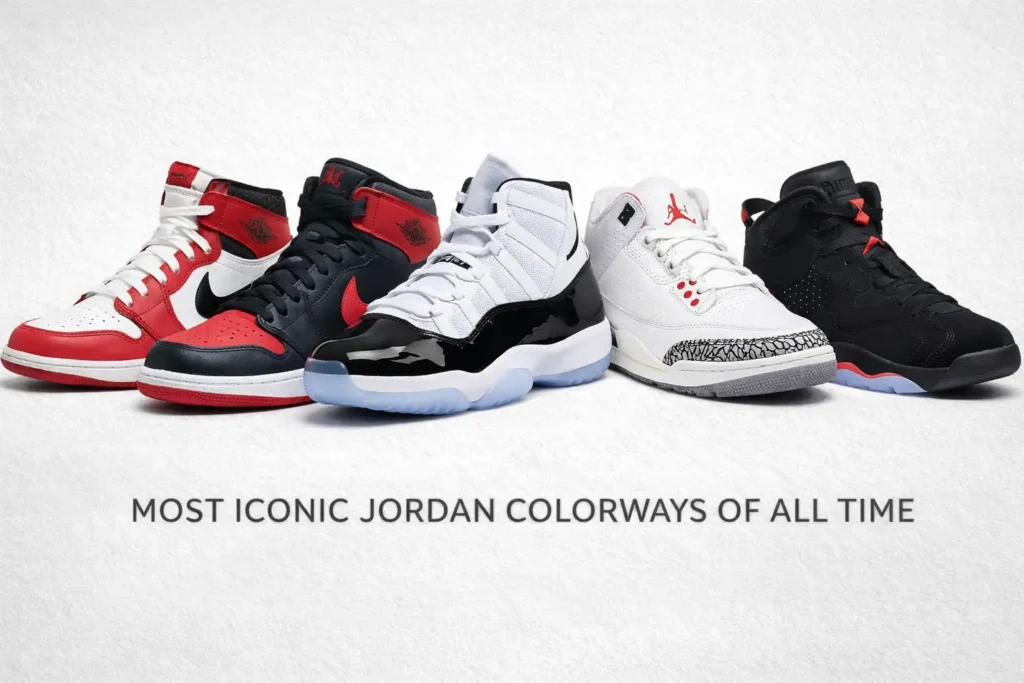
Air Jordan has produced hundreds of colorways across 40 years and two dozen silhouettes. But only a handful carry the kind of weight that turns a sneaker into a cultural artifact. This list finds those — ranked by three factors: historical story, cultural adoption, and resale market longevity.
What Makes a Jordan Colorway “Iconic”?
Plenty of colorways are popular. Iconic is a different category entirely.
For this ranking, we used three criteria:
1. Historical story: Is there a real, documented moment — a game, a ban, a dunk, a film — directly connected to this shoe? Colorways without stories are just products.
2. Cultural adoption: Did the shoe travel beyond the basketball court? Did it appear in music, film, streetwear, or art — and earn its place there?
3. Resale longevity: Does the shoe hold value across multiple retro generations? Consistent demand over decades is the market’s clearest signal that something still matters.
The 10 Most Iconic Jordan Colorways of All Time
#10: Air Jordan 1 “Shadow” — The Stoic One
The “Shadow” does not shout. It never needed to.
One of the original 1985 colorways — black and medium grey premium leather, clean lines — the Shadow was the AJ1 for people who understood the shoe without needing the story explained. It was the downtown colorway. The one that said everything by saying nothing.
The 2021 retro confirmed its devoted following. Sold out immediately. Resale: $200–$250. Not spectacle. Just conviction.
#9: Air Jordan 1 “Shattered Backboard” — The Dunk That Broke Glass
On August 25, 1985, in Trieste, Italy, Michael Jordan dunked with such force that the backboard shattered. The glass rained down on the hardwood floor. The gym went silent.
He wore his Chicago AJ1s during the game. But the colorway Nike created to honor the moment drew from the jersey on his chest — the Stefanel Trieste kit in orange, black, and cream. The result is one of the most visually distinctive AJ1 colorways ever made: not obvious, not safe, but unforgettable once explained.
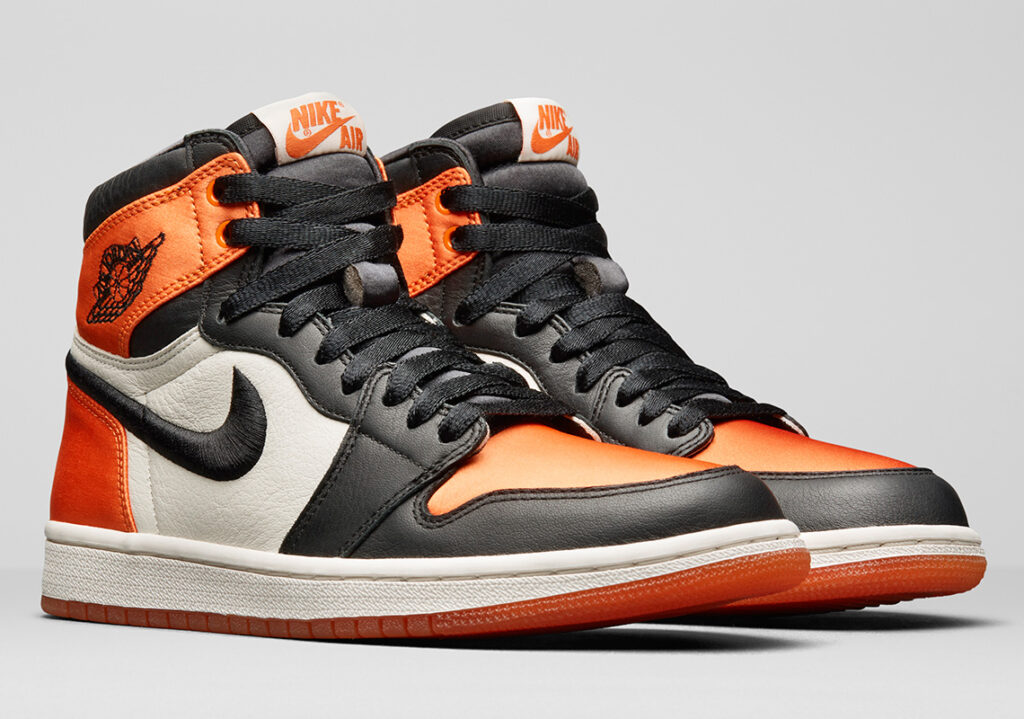
Nike released the first “Shattered Backboard” in 2015 for the 30th anniversary. StockX resale: $320–$1,998 depending on year and condition.
The Shattered Backboard is the best storytelling shoe in the Jordan line. The story is a man breaking physics before anyone thought to film it.
#8: Air Jordan 11 “Space Jam” — Where Basketball Met Hollywood
In 1996, Michael Jordan filmed Space Jam alongside the Looney Tunes — and wore a player exclusive AJ11 throughout production. Black patent leather, Concord blue Jumpman, #45 on the heel for his comeback number. Not available to the public. But the film ensured everyone knew exactly what they looked like.
Space Jam was many viewers’ entry point into understanding that a shoe could mean something beyond basketball. The AJ11 Space Jam is the shoe that proved sneakers could be cinematic.
First retail release: 2000. Retros in 2009 and 2016. MJ’s original film player sample sold at Sotheby’s for $176,400 in 2021.
Average retro resale: $370–$460.
#7: Air Jordan 3 “Black Cement” — The Dark Twin
If the White Cement is the Jordan 3’s declaration, the Black Cement is its threat.
Same Tinker Hatfield silhouette — the 1988 redesign that saved the Jordan line — but in black nubuck with elephant print toe and heel overlays. Jordan wore the Black Cement at the 1988 NBA All-Star Game itself (the evening after his White Cement-clad Dunk Contest win).
The 2018 “Reimagined” retro used original-spec nubuck throughout — one of the most material-accurate retros ever released. Resale: $300–$500+.
Two AJ3s. One legacy.
#6: Air Jordan 4 “Bred” (Black Cement) — The Shot
May 7, 1989. Game 5. Series on the line. Three seconds left.
Michael Jordan caught the ball at the foul line extended, took one dribble right to shed the defender, rose over Craig Ehlo, and — for one suspended moment — hung in the air longer than physics suggests is possible. The ball dropped through. Jordan exploded upward, both fists clenched, feet still off the ground.
He was wearing the Air Jordan 4 “Bred.” Black nubuck, cement grey, red Jumpman.
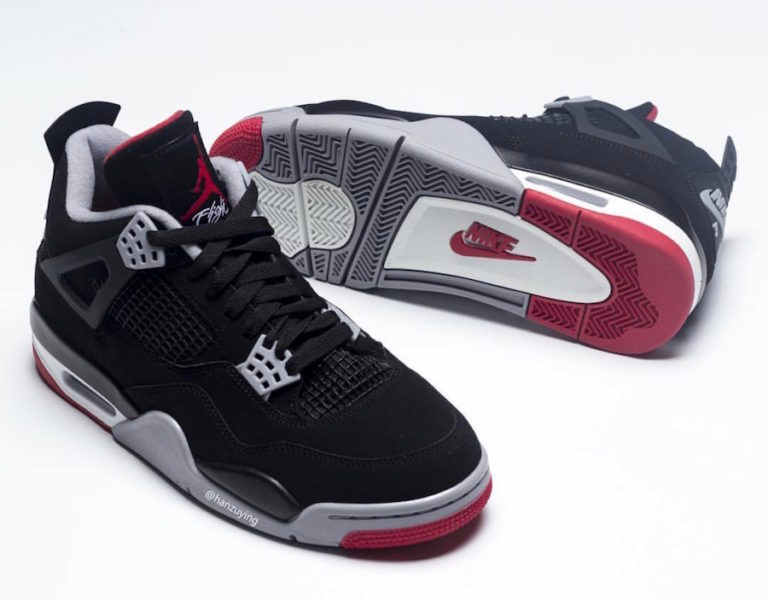
The AJ4 also appeared on Buggin’ Out’s feet in Spike Lee’s Do The Right Thing the same year — a film that captured Brooklyn at its most charged. Two defining cultural moments, 1989, one shoe.
Retros resell at $200–$350. An OG nubuck version remains among the most sought-after retro specifications in any Jordan model.
#5: Air Jordan 6 “Infrared” — The Championship Shoe
Tinker Hatfield designed the Air Jordan 6 like the sports car Michael Jordan drove — clean angles, pure function, built for speed. The “Infrared” colorway executed that in pigment: black nubuck, neon-red accents against white, the urgency of a car accelerating through a tunnel at night.
Jordan wore them throughout the entire 1991 NBA Playoffs — including the Finals, where the Chicago Bulls defeated the Lakers 4-1 for the franchise’s first championship.
Every dynasty has its coronation shoe. The AJ6 Infrared is the shoe from the one that defined an era.
A game-worn pair from the 1991 Finals — gifted to Nike’s Sonny Vaccaro — sold at auction for over $252,000. Retro resale: $250–$338.
#4: Air Jordan 3 “White Cement” — Where the Jumpman Was Born
By 1987, Michael Jordan was prepared to leave Nike.
He felt the first two Jordan shoes did not reflect who he was. Adidas was interested. So was Converse. Then Tinker Hatfield presented the Air Jordan 3 — and everything changed.
Visible Air cushioning in the heal (first time in the Jordan line). Mid-top silhouette. Elephant print overlays. And a new logo: not the Wings, but a figure caught mid-flight, arms wide, rising above the frame. The Jumpman.
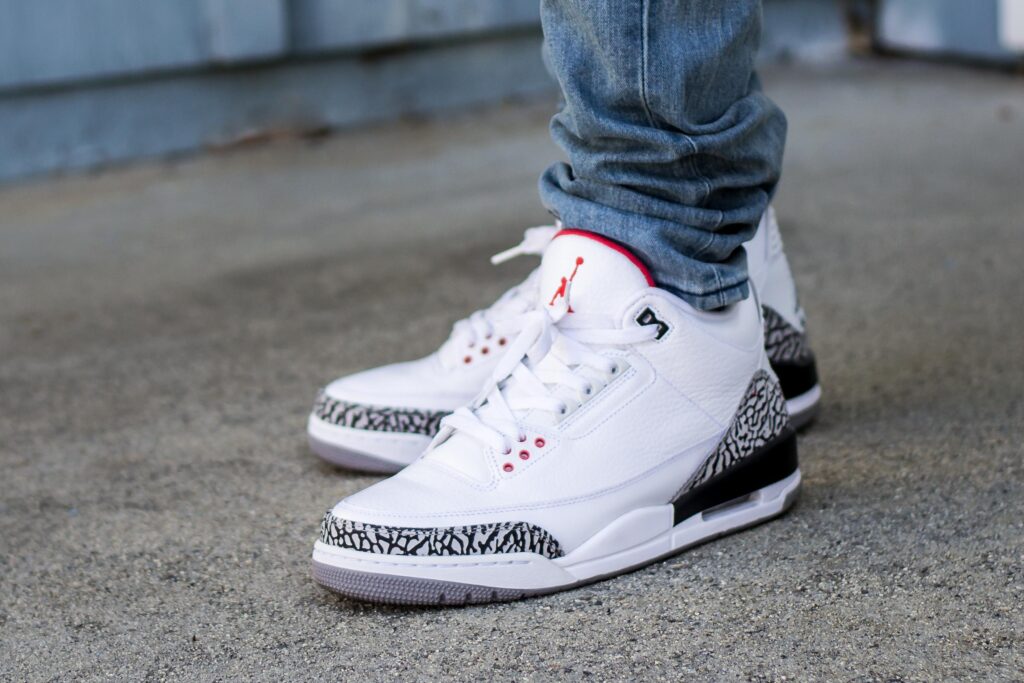
Jordan wore the White Cement on February 6, 1988 at the NBA Slam Dunk Contest. He took off from the free-throw line — 15 feet from the basket — and dunked. The crowd gave a standing ovation before the judges scored it. The dunk is still the greatest in contest history.
The sneaker he was wearing when he did it introduced the Jumpman logo to the world. That logo now appears on billions of garments worldwide. It started here.
Average retro resale: $220–$280.
#3: Air Jordan 11 “Concord” — The Shoe That Changed What Basketball Meant
Tinker Hatfield’s vision was direct: create a basketball shoe elegant enough to wear to a formal event.
The result — patent leather mudguard, ballistic mesh upper, icy outsole, clean Concord blue accents — was unlike anything in athletic footwear. Nike marketed it as a “tuxedo for your feet.” People wore it to proms. To black-tie events. A basketball shoe was showing up at formal dinners, and nobody questioned it.
Michael Jordan debuted the Concord in Game 1 of the 1995 Eastern Conference Finals, before the official launch. Non-compliant colorway. Fined by the NBA. Nike leveraged it again.
MJ has named the AJ11 his personal favorite shoe. Holiday Concord retros are the single most anticipated annual Jordan release — a tradition maintained for three consecutive decades. The 2011 retro caused documented mall incidents. The 2018 retro resold for $350+.
There was a before the Concord and an after. This colorway is the line between basketball shoes as equipment and basketball shoes as something much larger.
#2: Air Jordan 1 “Bred” — The One They Banned
October 18, 1984. Michael Jordan wore black-and-red sneakers in an NBA game. The shoes violated the league’s rule requiring footwear to be at least 51% white. The NBA fined him $5,000 for every game he wore them.
Nike paid every fine. Without hesitation.
Then they ran a commercial:
“On October 15th, Nike created a revolutionary new basketball shoe. On October 18th, the NBA threw them out of the game. Fortunately, the NBA can’t keep you from wearing them.”
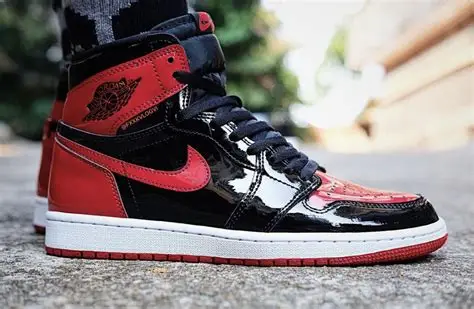
The commercial did not sell a shoe. It sold an identity. To wear the Bred was to declare that you do your thing when institutions say you cannot. The shoe carried the weight of that declaration with every wear.
The ban is not just a marketing footnote. It is the reason Jordan Brand became a cultural force, not simply a footwear product line. It is the story that made Nike the company it became.
Retros consistently resell at $250+. The phrase “the banned shoe” still works as cultural shorthand, 40 years on. That is the definition of iconic.
#1: Air Jordan 1 “Chicago” — The One That Started Everything
April 1, 1985. The Air Jordan 1 “Chicago” goes on sale at $65. Nike had projected $3 million in sales over three years.
It made $126 million in year one.
The color palette seems simple now: university red, black, and white, echoing the Chicago Bulls uniform. But in 1985, against the all-white basketball shoes that dominated the market, it was a visual argument — precise, confident, and impossible to refute. Red leather on white. A black Swoosh cutting through. The Wings logo embossed on the ankle like a seal on something that intended to last.
For 40 years, no version of that argument has been made better.
The 2022 “Lost & Found” retro added aged leather, pre-yellowed accents, a mismatched box — the full concept built around the fantasy of discovering a 1985 pair in a dusty stockroom, untouched for decades. Retail: $180. Resale: up to $578. Nike understood that the Chicago’s power is not in newness. It is in what it represents.
Game-worn examples have sold at auction for six figures. The color combination is among the most referenced in fashion, design, and visual culture across every medium and industry.
The AJ1 Chicago is not just a shoe. It is a point of origin — the moment when sneakers stopped being equipment and started being culture. Everything that came after is a consequence of what happened on April 1, 1985.
Honorable Mentions: The Collaborations That Changed the Rules
The Top 10 focuses on colorways tied to real Jordan career moments. These are different — pairs that prove the Jordan line remains the most relevant silhouette in sneaker culture without Michael Jordan needing to be on the court.
Travis Scott x Air Jordan 1 “Mocha” — La Flame’s reverse Swoosh (flipped backward on one shoe) was the most audacious design decision on a Jordan 1 since Peter Moore drew the Wings logo in 1984. It started a trend that every brand is still chasing. Current resale: $1,500–$3,000+.
Off-White x Air Jordan 1 “Chicago” — Virgil Abloh deconstructed the most iconic colorway in sneaker history: exposed foam, hand-written typography on the shoe surface, a zip-lock bag for the laces, quotes about walking printed on the insole. It looked unfinished and felt more complete than anything Nike had released in years. Resale: $5,000–$10,000.
Dior x Air Jordan 1 — 8,500 pairs globally. Retail: $2,000–$2,200. Resale: $7,000–$25,000. Not a marketing play. A reclassification: sneaker culture was no longer aspiring to high fashion — high fashion was coming to it.
Air Jordan 11 “Bred” — Released Christmas Day 2019, the all-black-with-red-Jumpman AJ11 broke StockX single-day records. The holiday release tradition the AJ11 created came full circle in its darkest form.
How to Build Your Fit Around These Colorways
The shoes are settled. The question is what you wear with them.
AJ1 Chicago or Bred: Red, white, and black is the most versatile three-color combination in streetwear. A fitted black tee, clean white joggers, and a red accented jacket pulls the colorway into the entire outfit — not just drawing attention to the feet. Browse dunkare’s Chicago-inspired matching sets for a coordinated look built around the colorway from the ground up.
AJ11 Concord: Patent leather and white demand a cleaner approach. Go monochrome — white-on-white with a single navy or black accent. The shoe has enough visual complexity to anchor the entire fit. Don’t compete with it.
AJ3 White Cement or AJ4 Bred: These are urban classics. Grey heavyweight sweats, a white tee, a dark hoodie. Let the shoe anchor the look from the ground upward — it has been doing exactly that since 1988.
Frequently Asked Questions
What is the most iconic Jordan colorway of all time?
The Air Jordan 1 “Chicago” (1985) is considered the most iconic Jordan colorway of all time — connected to MJ’s rookie season, the NBA ban story, and 40 years of continuous cultural resonance.
Which Jordan colorways are most valuable on the resale market?
The Dior x Air Jordan 1 ($7,000–$25,000), Off-White x AJ1 Chicago ($5,000–$10,000), and Travis Scott x AJ1 Mocha ($1,500–$3,000+) are consistently the highest-resale retail pairs. Game-worn originals — AJ1 Chicago and AJ6 Infrared — trade at six figures.
Why was the Air Jordan 1 Bred banned by the NBA?
The colorway violated the NBA’s rule requiring shoes to be at least 51% white. Nike paid the $5,000 per-game fines in full and turned the ban into one of the most effective brand campaigns in marketing history.
What was Michael Jordan’s first championship shoe?
The Air Jordan 6 “Infrared” — black nubuck with neon-red accents, designed by Tinker Hatfield. Jordan wore them throughout the 1991 NBA Finals when the Bulls defeated the Lakers 4-1 for their first title.
Which Air Jordan 11 colorway is most iconic?
The Concord is the definitive AJ11 colorway — for its design innovation (first patent leather basketball shoe), MJ’s unauthorized 1995 debut, and sustained cultural impact across three decades of holiday retros. The Space Jam is a close second for its cinematic permanence.
Are Jordan retros worth buying as investments?
Some are. Collaborative pairs (Off-White, Travis Scott, Dior) have shown consistent appreciation. Core colorway retros (Chicago, Bred, Concord) hold value but fluctuate on supply and condition. Always verify current pricing on StockX or GOAT before purchasing for investment purposes.