Nike predicted $3 million in sales over three years. The Air Jordan 1 made $126 million in twelve months. Nobody saw that coming – not the NBA, not the retailers, and honestly, probably not Nike either.
The history of Air Jordan sneakers is not just the story of a shoe. It is the story of how one athlete, one company, and one bold deal rewrote the rules of sports, fashion, and culture simultaneously. Whether you are a lifelong collector or someone who just laced up their first pair of 1s, understanding where Jordans come from makes every wear feel different. This is that story – four decades of it.
The Deal That Changed Everything (1984)
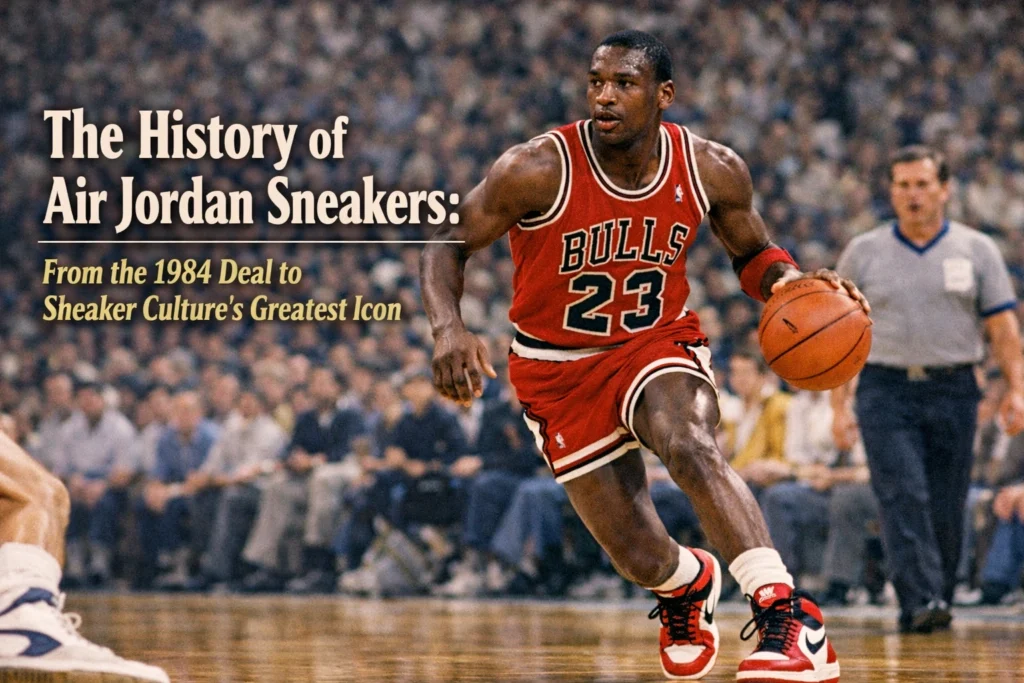
By the summer of 1984, Michael Jordan had just finished a legendary college career at North Carolina and was about to be drafted third overall by the Chicago Bulls. Every major shoe brand was paying attention.
Jordan’s preference? Adidas. He also had Converse as an option – the reigning king of basketball shoes at the time, worn by NBA stars like Larry Bird and Magic Johnson.
Nike was the underdog in this race. But they made an offer the others could not match: a five-year deal worth $2.5 million plus royalties, with one unique addition – his own signature shoe line1. No basketball player had ever been given that before.
Jordan almost said no. His mother, Deloris Jordan, convinced him to at least hear Nike out. After the pitch, he was on board.
His agent, David Falk, came up with the name “Air Jordan” – a blend of Nike’s signature Air cushioning technology and Jordan’s reputation for playing like he had wings. It stuck immediately.
The Air Jordan 1 – Born to Be Banned (1985)
Designer Peter Moore got to work. On November 17, 1984, the first pair was produced specifically for Michael Jordan. The public got their chance on April 1, 1985 – priced at $65.
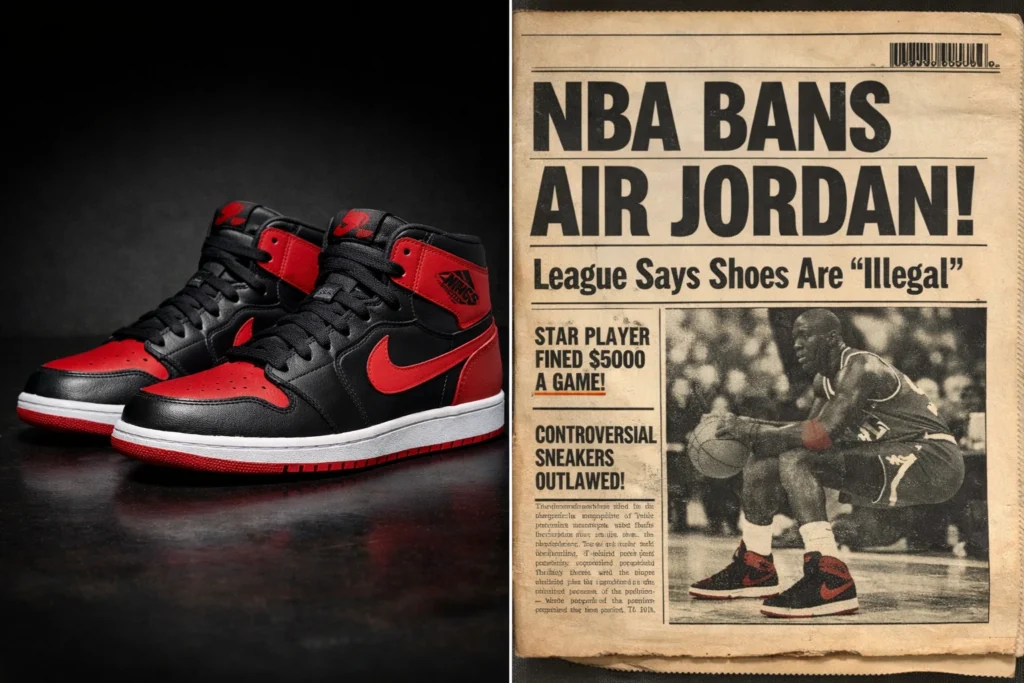
The shoe featured the Nike Swoosh logo and the “Wings” emblem, a basketball with wings spread on both sides. But the colorway that grabbed everyone’s attention was the black and red “Bred” – and it grabbed the NBA’s attention for the wrong reasons.
The league had a rule: game shoes had to be at least 51% white and consistent with team uniforms. The Bred Air Jordan 1 was not even close. The NBA sent Jordan a warning, then started fining him $5,000 every game he wore them2.
Nike paid every single fine.
Then they filmed a commercial. “On October 15th, Nike created a new basketball shoe,” the voiceover said. “The NBA has since banned them. Fortunately, the NBA can’t stop you from wearing them.”
The “banned shoe” became the most talked-about sneaker in America. Demand exploded. What Nike projected would take three years to sell, they sold in one – $126 million worth3.
Tinker Hatfield and the Design Revolution (1987-1995)
After Peter Moore left Nike in 1987, a new designer stepped in for Air Jordan 3: Tinker Hatfield. What he created over the next decade would define the golden age of Air Jordan design.
Air Jordan 3 (1988) – The Jumpman is Born
The Air Jordan 3 was unlike anything that came before it. It was the first mid-cut basketball sneaker in the Jordan line. Hatfield introduced visible Air-Sole cushioning in the heel – you could literally see the technology working. He also added the elephant print pattern that collectors still love today.
But the biggest debut on the Air Jordan 3? The Jumpman logo – that iconic silhouette of Michael Jordan mid-dunk that now lives on everything from caps to matching tees4.
The shoe also got an important cultural co-sign. Nike’s commercials featuring filmmaker Spike Lee as his character Mars Blackmon put Air Jordans squarely in the conversation of hip-hop culture and street credibility. Mars would beg Jordan to reveal the secret of his play, always insisting “It’s gotta be the shoes.” It was funny, it was authentic, and it worked.
The Air Jordan 3 is widely credited with saving the Jordan-Nike partnership at a moment when Jordan was open to leaving. It became a turning point not just for a shoe, but for what Nike could become.
Air Jordan 4 (1989) and Air Jordan 6 (1991)
The Air Jordan 4 expanded the line’s global footprint – it was the first Jordan shoe sold internationally. The Air Jordan 6, released in 1991, holds a special place in Jordan’s personal history: he wore it during his first NBA championship win. First of six.
Air Jordan 11 (1995) – Tuxedo for Your Feet
Tinker Hatfield outdid himself with the Air Jordan 11. Nobody had ever put patent leather on a basketball sneaker before. Hatfield added a carbon fiber midfoot shank plate for performance and kept the silhouette sleek enough that Nike marketing called it “a tuxedo for your feet.”
Jordan famously debuted the white/black Concord colorway during the 1995 NBA Playoffs – his comeback after his first retirement – against Hatfield’s own advice, since the shoe was still in testing5. The NBA fined him for it. Again.
People started wearing the Air Jordan 11 to proms and galas. Both Hatfield and Jordan have named it their all-time favorite model.

Key Air Jordan Models at a Glance
| Model | Year | Designer | Notable Feature |
|---|---|---|---|
| Air Jordan 1 | 1985 | Peter Moore | First AJ; NBA banned the Bred colorway |
| Air Jordan 3 | 1988 | Tinker Hatfield | Jumpman logo debut; visible Air unit |
| Air Jordan 4 | 1989 | Tinker Hatfield | First AJ sold internationally |
| Air Jordan 6 | 1991 | Tinker Hatfield | Jordan’s first championship shoe |
| Air Jordan 11 | 1995 | Tinker Hatfield | Patent leather; “tuxedo for your feet” |
These five models form the backbone of Jordan legacy – and their cultural reach only grew from here.
Beyond Basketball – Jordan Brand and Hip-Hop (1997-2009)
In 1997, the Air Jordan line officially became its own entity: Jordan Brand, a subsidiary of Nike. Michael Jordan had retired (again), but the shoes kept selling like he was still playing.
This era cemented what was already obvious: Air Jordans were no longer just basketball shoes. They were cultural currency. Jay-Z wore them on stage. LL Cool J rapped about them. Nas’s early photos showed them front and center – Jordans were part of the visual language of hip-hop before hip-hop was a mainstream industry6.
Knowing how to wear Jordan 1s was as important as knowing which ones to get. The shoe had become as much about self-expression as performance.
The retro strategy also kicked into full gear. Nike began re-releasing classic models – bringing the Black Toe 1, the Cement 3, the Bred 4, and others back for new generations who had missed them the first time. Every retro release was an event.
The Sneakerhead Era and Resale Culture (2010s-Present)
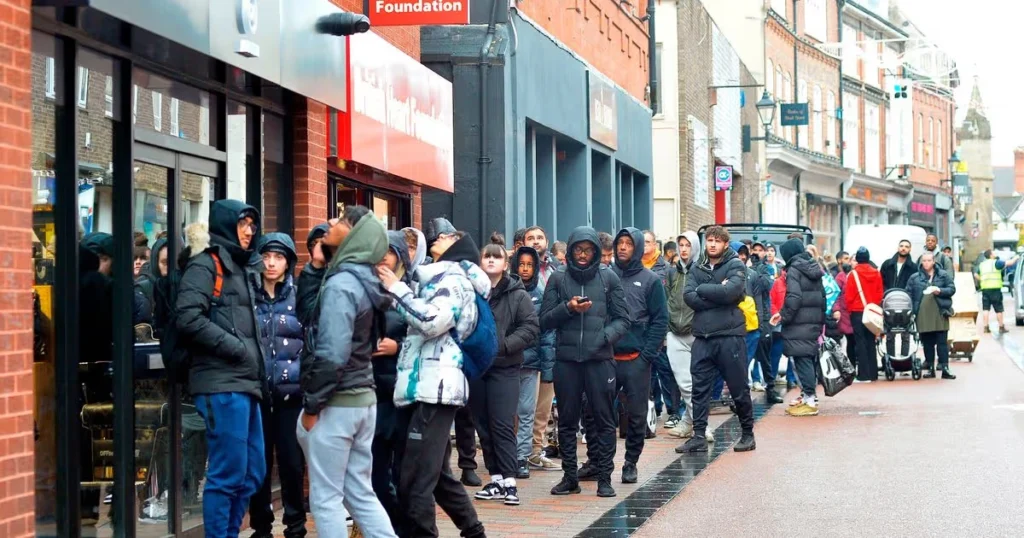
The 2010s turned what had been enthusiasm into a full industry. With the rise of resale platforms, sneaker conventions, and social media, Air Jordans became investment-grade assets.
The numbers are hard to ignore. Jordan Brand holds a 28% share of the entire secondary sneaker market7. In 2020 alone, combined Nike and Air Jordan resale revenue hit $7.1 billion. The average Air Jordan resells for 59% above its original retail price. The Air Jordan 1 alone accounts for 23% of the entire secondary sneaker market. It resells for an average of $260 – an 85.7% premium over its retail value.
The highest sale ever? Michael Jordan’s game-worn Air Jordan 13 from the 1998 NBA Finals – the “Last Dance” pair – sold at auction for $2.2 million in April 2023.
Collaborations have kept the brand at the center of culture. Travis Scott’s reverse-Swoosh Air Jordan 1 became one of the most talked-about sneakers of the decade. Collabs with Eminem, Kendrick Lamar, and Megan Thee Stallion have blurred the line between sneaker brand and art object.
The Air Jordan 11 has released in a new colorway every December since 2009 – an annual tradition as reliable as the holidays themselves.
Why Air Jordans Still Matter Today
Every sneaker brand has tried to recreate what Jordan Brand built. Some have come close. None have matched it.
When ESPN released “The Last Dance” documentary in 2020, it introduced an entirely new generation to Michael Jordan’s story – and with it, a new wave of collectors and fans. Vintage pairs that had sat in closets for decades suddenly became grails again. The Air Jordan 1, the Air Jordan 3, the Air Jordan 11 – demand spiked across all of them.
The reason they still resonate is simple: Jordan sneakers carry 40 years of actual history. When you put on a Jordan 3, you are wearing the shoe that saved a partnership and introduced the Jumpman to the world. When you wear a Jordan 11, you are wearing Tinker Hatfield’s personal favorite – a sneaker so clean it crossed from the court into formal events.
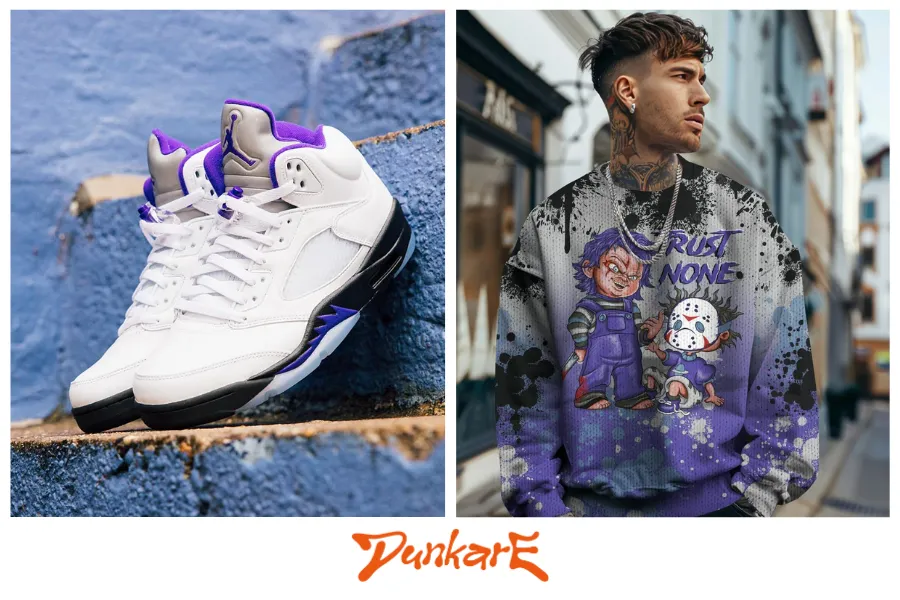
That history is part of what makes matching your outfit to your Jordans feel like more than just getting dressed. You are honoring something that genuinely matters.
Frequently Asked Questions
When was the first Air Jordan shoe released?
The Air Jordan 1 was produced on November 17, 1984, and officially released to the public on April 1, 1985, priced at $65.
Why were Air Jordans banned by the NBA?
The original black and red “Bred” Air Jordan 1 violated the NBA’s rule requiring game shoes to be at least 51% white and consistent with team uniform colors. Michael Jordan wore them anyway; the NBA fined him $5,000 per game, which Nike paid on his behalf.
Who designed the Air Jordan shoes?
The Air Jordan 1 was designed by Peter Moore. From the Air Jordan 3 onwards, legendary designer Tinker Hatfield took over, creating many of the most iconic models including the AJ3, AJ4, AJ6, and AJ11.
What is the Jumpman logo?
The Jumpman is a silhouette of Michael Jordan performing a slam dunk. It first appeared on the Air Jordan 3 in 1988, designed by Tinker Hatfield, and has since become one of the most recognizable logos in sports and fashion history.
What is the most expensive Air Jordan ever sold?
Michael Jordan’s game-worn Air Jordan 13 from the 1998 NBA Finals – known as “The Last Dance” pair – sold at auction for $2.2 million in April 2023.
Conclusion
From a controversial $65 sneaker that nearly got Michael Jordan’s agent a cease-and-desist from the NBA, to a $2.2 million auction price for a game-worn pair – Air Jordans have traveled a long, remarkable road.
The history of Air Jordan sneakers is the history of how sports became fashion, how fashion became culture, and how culture became something you can actually wear on your feet. Every colorway tells a chapter of that story.
Now that you know where they came from, it is time to honor the legacy. Lace up your pair, build your outfit around them, and wear it with everything the history behind them deserves.
- Wikipedia – Air Jordan, https://en.wikipedia.org/wiki/Air_Jordan
- Nike.com – History of the Air Jordan ban, https://www.nike.com
- Wikipedia – Air Jordan, https://en.wikipedia.org/wiki/Air_Jordan
- Sotheby’s – The History of the Air Jordan 3, https://www.sothebys.com
- Footdistrict – Air Jordan 11 Concord history, https://footdistrict.com
- Hot New Hip Hop – Jordan Brand and Hip Hop collaborations, https://hotnewhiphop.com
- RunRepeat – Sneaker Resale Market Analysis, https://runrepeat.com