In April 2023, a pair of game-worn Air Jordan 13s from the 1998 NBA Finals sold for $2.2 million. A few weeks later, a man in Ohio paid $180 for a pair of retro Air Jordan 3 White Cements — the same shoe he had wanted since eighth grade but could never afford.
Both of them called their purchase a grail. Both of them were right.
“Grail” is one of the most used — and most misused — words in sneaker culture. It gets applied to every hyped release within hours of a drop announcement, confused with “expensive,” and stripped of its real meaning by people who have wanted a shoe for 48 hours, not 10 years.
This article defines what actually makes a sneaker a grail — the 5 criteria, the difference between grails and hype, the most legendary grails ever sold, and a personal framework for knowing when you have found yours.
Where the Word Comes From
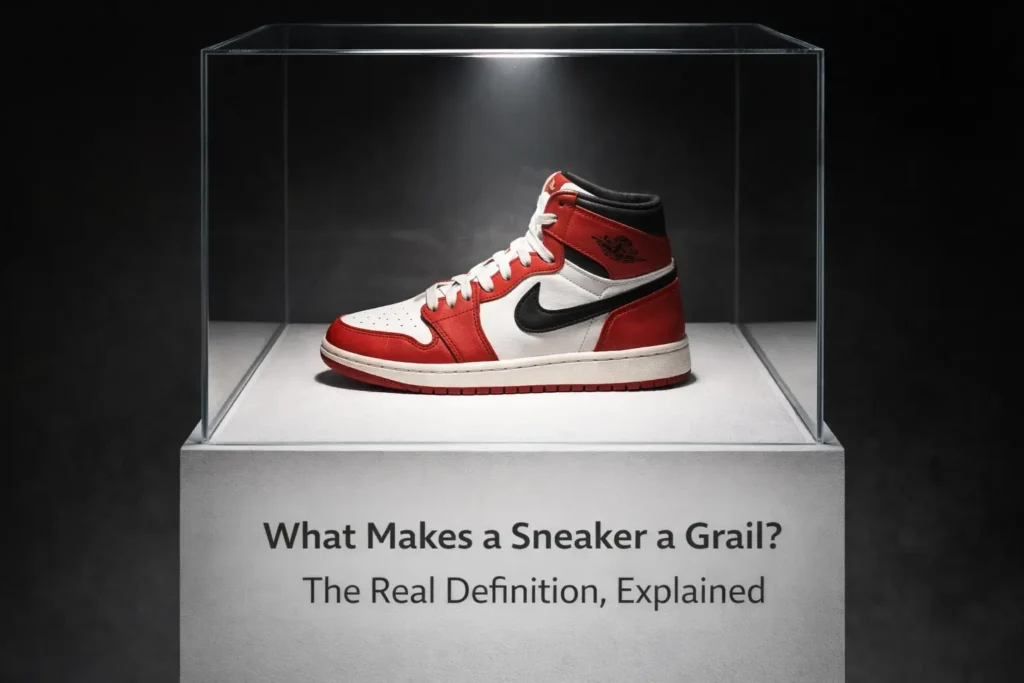
The term comes from the Holy Grail — the object of singular importance in Arthurian legend, requiring devotion and sacrifice to obtain. Sneaker culture adopted it in the early 2000s as collecting became more structured and online communities formed to classify desire.
In sneaker language, a grail is the shoe you want most but do not yet have. The crown jewel. The pair you would prioritize above everything else in your collection.
The 5 Things That Actually Make a Sneaker a Grail
1. Rarity — It Has to Be Hard to Get
Almost every grail carries some form of scarcity. Limited production runs. Regional exclusives. Friends-and-family releases. Cancellations due to legal issues. Or simply being decades out of circulation with no retro on the calendar.
The extremes are staggering:
- Wu-Tang Clan Nike Dunk High — 36 pairs believed to exist
- Nike SB Dunk Low “Paris” — fewer than 200 pairs, each with unique Bernard Buffet artwork
- Nike SB Dunk Low “Yellow Lobster” — 34 pairs for F&F; resale: $45,000–$60,000
- Eminem x Carhartt Air Jordan 4 — never publicly released; auction prices: $20,000–$30,000
Rarity alone does not make a grail. But scarcity is what turns “I want that shoe” into “I need to find that shoe.” That shift in language is where grail status begins.
2. Personal Meaning — It Has to Mean Something to You
This is the criterion that separates collectors from trend followers. And it is the one most people skip.
A grail does not need to cost thousands. It does not need to appear on a Sotheby’s lot or a Complex top-10 list. It needs to mean something to you — specifically, personally, and irreplaceably.
Maybe it is the shoe you saw on your older brother’s shelf as a kid and never forgot. Maybe it is a pair taped to your bedroom wall from a Foot Locker ad in 2003. Maybe it is a general release Air Max 90 that your dad wore every weekend — and you have been searching for that exact colorway for three years because the shoe reminds you of Saturday mornings before everything changed.
Here is the test: if the resale price dropped to $50 tomorrow, would you still want it?
If yes, the shoe carries personal meaning. If no, you were chasing a market — not a grail.
3. A Story Behind It — History Adds Weight
The most universally recognized grails carry narratives that connect to moments larger than sneakers.
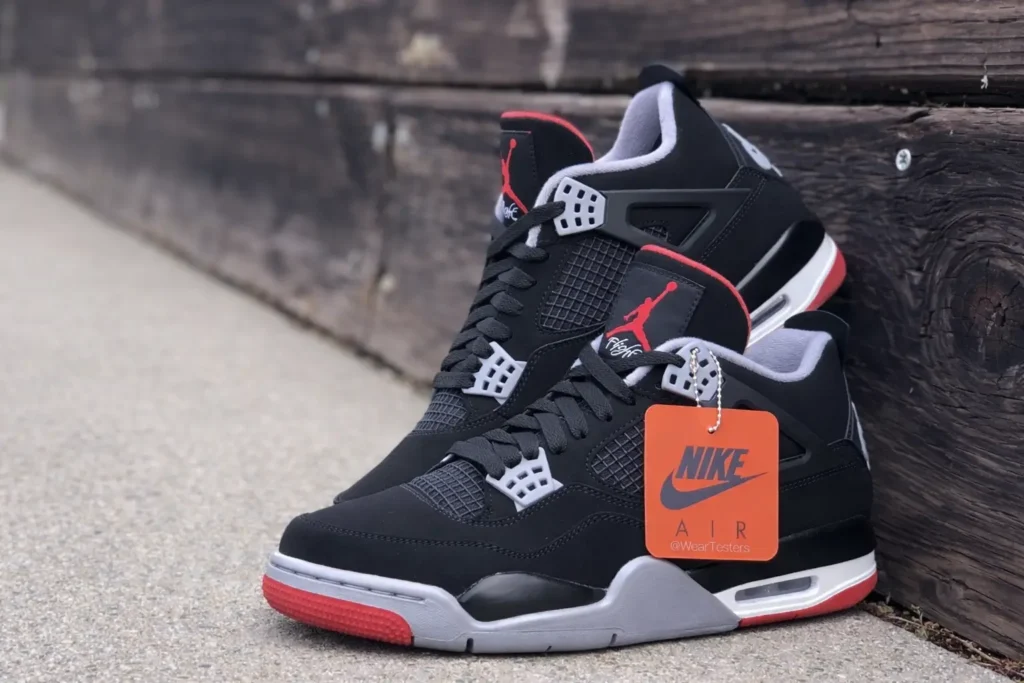
The Air Jordan 1 “Bred” was banned by the NBA — and Nike paid the fines and turned the ban into an ad campaign. The Air Jordan 4 “Bred” was on Michael Jordan’s feet when he hit “The Shot” over Craig Ehlo. The Nike MAG was designed for Back to the Future II — and then Nike actually built it. The Air Yeezy 1 “Grammy” prototype was worn by Kanye West during a live performance that permanently changed how music and fashion intersect.
Cultural moments — championship games, concerts, NBA bans, Hollywood films — transform products into artifacts. And artifacts are what grails truly are.
4. The Pursuit — The Journey Matters
A grail is never something you add to cart and check out. The pursuit — months of searching, saved eBay alerts, money set aside week by week, connections leveraged through friends or forums — is part of what gives the shoe its weight.
A shoe you can buy anytime is a great shoe. A shoe you tracked for 14 months, found in a half-size from a seller in Tokyo, authenticated through two platforms, and finally laced up on a Tuesday evening while sitting on your bedroom floor — that shoe is a chapter in your own story.
The chase is not a barrier to a grail. It is the point.
5. Condition — Preservation Tells Its Own Story
For market-facing grails, condition is decisive. Deadstock (unworn, original box, all original accessories) commands dramatic premiums. A 1985 AJ1 Chicago in deadstock condition is a $20,000+ conversation. The same shoe in worn condition trades at a fraction.
But condition is not the only lens. “Beater grails” — shoes worn into the ground precisely because they were loved — are their own respected category. A pair re-laced three times, repaired once, and worn through five years of real life is not damaged. It is proof of devotion.
Grail vs. Hype — Why the Difference Changes Everything
These two words are not interchangeable. Confusing them is the most common mistake in sneaker culture — and understanding the difference changes the way you collect permanently.
Hype is widespread public excitement. It is driven by marketing campaigns, celebrity endorsements, social media, and the manufactured promise of scarcity. Hype makes a shoe desirable to many people simultaneously — often regardless of personal connection or genuine aesthetic preference. Hype is external.
Grail is personal, enduring significance. A grail is desirable to you — independently of what the market, a celebrity’s Instagram, or a resale app tells you it is worth. Grails persist when the trend cycle moves on. Grails are internal.
The test is time: when the trend passes, does the desire remain?
If yes, the shoe was always a grail. If the desire fades the moment the next collaboration drops, it was hype — and that is fine, but it is not the same thing.
A hyped shoe can become a grail if the personal connection deepens over time. But most hyped releases never cross that line. Chasing hype for validation — for the post, the resale margin, the comments — is the opposite of grail hunting. Grail hunting is knowing what you actually want when nobody else is watching.
The Most Legendary Grails of All Time
Some shoes transcend personal collections and become universal grails — recognized across the entire culture as the most coveted pairs ever produced.
$2.2 million — Michael Jordan’s game-worn Air Jordan 13 from the 1998 NBA Finals. The “Last Dance” shoe. The most expensive sneaker ever sold at auction.
$1.8 million — Nike Air Yeezy 1 “Grammy” Prototype. Worn by Kanye West at the 2008 Grammys. A Guinness World Record when it sold in 2021.
$1.47 million — 1985 game-worn Nike Air Ships. The shoe Jordan wore before the Air Jordan 1 existed.
$300,000 — Louis Vuitton x Nike Air Force 1, designed by Virgil Abloh. 200 pairs released via Sotheby’s auction.
$50,000–$100,000+ — Nike MAG (2016, self-lacing). The shoe from Back to the Future II, actually manufactured.
$50,000+ — Nike SB Dunk Low “Paris.” Fewer than 200 pairs. Each one a unique painting on leather.
$20,000+ — Air Jordan 1 “Chicago” OG 1985 (deadstock). The shoe that started everything.
These numbers are extreme. But the principle they illustrate is universal: a shoe that carries a story can become worth infinitely more than its materials ever suggested.
How to Find Your Own Grail: The 5-Question Test
Not sure if you have a grail? Answer these honestly:
1. Does the shoe carry meaning to you beyond its market value?
2. Would you still want it if the resale price dropped to $50?
3. Does the story behind the shoe connect to something in your own life?
4. Have you been thinking about it for months or years — not just since the last Instagram post?
5. If you could only keep one pair in your entire collection, would it be this one?
If you answered yes to three or more, you have found your grail. Stop reading and go get it.
Once You Find It, Style It Right
Your grail deserves more than a random outfit thrown together in 30 seconds. The shoe you waited years for should anchor a look built with the same intention.
AJ1 grails (Chicago, Bred, or any bold colorway): Red, white, and black is the most versatile palette in streetwear. A fitted black tee, clean white joggers, and a red accent jacket lets the shoe lead without competing. Browse dunkare’s matching sets for coordinated looks built around specific Jordan colorways.
AJ11 grails (Concord, Space Jam): Patent leather and white demand a cleaner approach. Go monochrome — white-on-white with a single dark accent. The shoe carries everything above it.
AJ3 or AJ4 grails: Grey heavyweight sweats, a white tee, a dark hoodie. Let the shoe anchor the entire fit from the ground up. These silhouettes have been doing exactly that since 1988.
Frequently Asked Questions
What does grail mean in sneaker culture?
A grail is a highly coveted, personally significant sneaker that a collector desires but does not yet own. It represents the crown jewel of a collection — the one shoe you would keep if you had to sell everything else.
What is the most expensive grail sneaker ever sold?
Michael Jordan’s game-worn Air Jordan 13 from the 1998 NBA Finals sold for $2.2 million in April 2023 — the highest price ever paid for sneakers at auction.
Can a general release shoe be a grail?
Yes. A grail is defined by personal meaning, not market price or production volume. A retro you missed as a teenager or a pair connected to a personal memory qualifies completely.
What is the difference between a grail and a hyped sneaker?
Hype is market-driven and often temporary. A grail is personal and enduring. The test: when the trend passes, does your desire remain? If yes, it was always a grail.
How do I know if a sneaker is my grail?
Ask yourself: would you still want it at $50? Have you been thinking about it for months or years? If you could keep only one pair, would it be this one? If yes — you have found your grail.
Find your grail’s perfect matching set at dunkare.com.