There was a time when wearing sneakers outside of a gym was considered underdressed. That time is over.
Today, a pair of Jordan 1s appears at the Met Gala. Sneakers sell at Sotheby’s for hundreds of thousands of dollars. The Dior × Air Jordan 1 had over five million people applying for a chance to buy it. Louis Vuitton built an entire menswear collection around a rubber-soled athletic shoe.
How did a shoe built for basketball courts end up in auction houses and on Fashion Week runways? The answer is one of the most fascinating stories in modern style — and it starts with athletes, gets taken over by artists, and ends somewhere no one predicted.
Built for Sports, Nothing Else (Late 1800s–1940s)
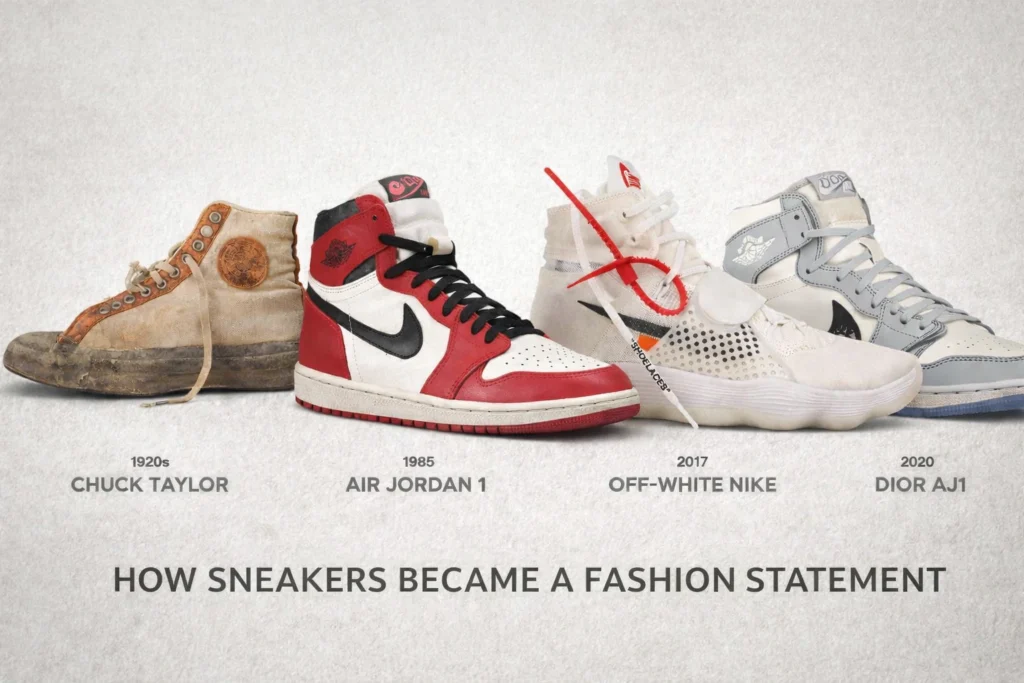
Sneakers began as rubber-soled “plimsolls” designed for grip and comfort during physical activity. The Converse All-Star, introduced in 1917 and endorsed by basketball player Chuck Taylor, became the dominant athletic shoe for forty years.
They were purely functional objects — worn in gyms, on courts, in training facilities, and nowhere else. Fashion had absolutely nothing to do with it. This is the baseline from which everything else measures its distance.
The First Defection: Teenagers in the 1950s
The first cultural crack appeared in the 1950s when American teenagers started wearing sneakers as deliberate everyday fashion — not because they were athletes, but because they were not. In the postwar era, young people used sneakers the way they used leather jackets and denim: as signals of rebellion against formal convention.
James Dean wore Converse as casual street wear. That image — a cultural icon in athletic shoes, outside their intended context — began the shift.
The 1960s and 70s deepened it. Vans (1966) and Nike positioned themselves for lifestyle, not just athletics. Adidas Superstars moved from basketball courts to the streets. The jogging craze of the 1970s made sneakers mainstream casual wear.
Sneakers had crossed into casual fashion. But the transformation from casual to cultural force? That required hip-hop.
Hip-Hop: The Moment Identity Entered Footwear (1980s)
In the late 1970s and early 1980s, hip-hop emerged from New York City as a cultural movement built entirely on self-expression. Artists turned every choice — clothing, music, movement, language — into a statement about who they were and where they came from. Sneakers were no exception.
Hip-hop artists wore specific brands and specific models as identity markers. The shoe you wore communicated your affiliation, your taste, and your street credibility. Not which sport you played — who you were.
Run-DMC crystallized this shift. The group wore Adidas Superstars without laces — not the way athletes wore them, but the way artists choose to. When they wrote “My Adidas” (1986), they transformed a tribute to a shoe into a cultural anthem. A few months later, at a Madison Square Garden concert, the group held up their Superstars and asked the crowd to do the same. Roughly 1,500 people raised theirs simultaneously. Adidas executives watched it happen from the audience.
The endorsement deal that followed was one of the first ever between a hip-hop act and a major sportswear brand. From that night, sneakers were no longer sportswear that people wore casually. They were a fashion medium — a way of making an artistic statement with the choice of what went on your feet.
Michael Jordan and the Status Symbol (1984–1985)
Nike signed Michael Jordan for $2.5 million over five years in 1984 — a deal that restructured how sports, marketing, and fashion intersect permanently.
The Air Jordan 1 launched in 1985 at $65. The black-and-red “Bred” colorway violated NBA uniform policies. Jordan was fined $5,000 per game. Nike paid every fine and produced a television commercial making the ban the entire selling point. The controversy did not damage the shoe — it made it mythological.
The AJ1 generated $126 million in its first year against a $3 million projection. It turned sneakers into status objects. The right pair communicated aspiration, cultural knowledge, and identity beyond sport.
From this point forward, sneakers and fashion were inseparable. The only question was how far fashion would take them.
The Sneakerhead Era: Collecting as Fashion Identity (1990s–2000s)
The 1980s and 90s produced a new figure in culture: the sneakerhead. Someone who collected rare and exclusive releases not as athletic equipment but as fashion artifacts — curated expressions of identity, cultural knowledge, and aesthetic taste.
The 1990s diversified the landscape. Nike Air Max, Reebok Pump, Vans Old Skool, Converse One Star — each became the signature shoe of a distinct cultural tribe, carrying specific fashion identity. Skateboarding, basketball, hip-hop, underground: you wore different shoes because you were saying different things about yourself.
By the 2000s, the fashion industry recognized what streetwear had known for two decades. Gucci, under Tom Ford, began producing sneakers in premium materials. Prada and Hermès applied haute couture craftsmanship to athletic silhouettes. The luxury world had arrived at the same conclusion the hip-hop world reached in 1986: a shoe is a statement.
Luxury Fashion’s Full Embrace (2010s)
The 2010s transformed sneakers from a fashion concession to a fashion centerpiece.
Gucci Ace (2016): Alessandro Michele’s vision — a clean low-top with the House Web stripe and embroidered motifs (bees, snakes, tigers). A luxury tennis shoe reimagined as wearable art.
Balenciaga Triple S (2017): The most provocative luxury sneaker moment — deliberately oversized, “ugly” by conventional standards, priced over $800. Not trying to be beautiful — trying to be challenging. The chunky sneaker trend it launched reshaped the entire market.
Chanel × Pharrell Williams: Rare collab pairs that merged the most formal fashion house with one of music’s most culturally mobile artists. Collector’s items immediately.
Luxury brands had both artistic and commercial motivations. Sneakers were the “gateway product” drawing younger buyers into their ecosystems. The shoe opened the door to the brand.
Virgil Abloh and “The Ten”: Sneakers as Wearable Art (2017)

Virgil Abloh trained as an architect. He approached design as a cultural conversation — not just aesthetics, but a dialogue with an object’s history and meaning. When Nike approached him for a collaboration, he did not design new colorways. He questioned what a sneaker fundamentally was.
“The Ten” (2017) reimagined ten classic Nike silhouettes: the Air Jordan 1, the Air Force 1, the Air Presto, the Air Max 90, the Blazer, and five more. Abloh exposed the construction — zip-ties dangling from lace cages, foam visible through cutouts, text labels in deliberate quotation marks (“SHOELACES,” “AIR,” “FOAM”) as if annotating the shoe’s own anatomy. Industrial orange stitching. The stencilled mark “OFF-WHITE™.”
These were not shoes being made more fashionable. They were shoes turned into philosophical statements about what a shoe can mean. They sold out the moment they appeared. They defined the late 2010s aesthetic. They remain among the most referenced sneakers in both high fashion and sneaker culture simultaneously.
Abloh later became Men’s Artistic Director at Louis Vuitton, placing sneakers at the center of Paris Fashion Week collections as primary fashion objects. His work proved a permanent truth: sneakers are not an exception in high fashion. They are its present language.
The Apex: Auction Houses, Red Carpets, Museum Walls (2020–Present)
The Nike × Dior Air Jordan 1 (2020) retailed at $2,200. Over five million people applied for the chance to buy it. It sold out in seconds.
Louis Vuitton × Nike Air Force 1 — Virgil Abloh’s final major project before his death in 2021 — went to auction at Sotheby’s. Individual pairs sold for $300,000 to $500,000.
Zendaya arrived at the Met Gala in Air Jordan 1s. Fashion editors photographed the shoes as carefully as the dress. No one considered them out of place.
Sneakers now appear on Paris, Milan, and New York Fashion Week runways. In permanent museum collections. At Sotheby’s dedicated sneaker auctions. On red carpets at the world’s most photographed events.
The transformation is complete. There is no longer a category called “casual shoes” that sits below “fashion.” There is only: what statement are you making?
The Fashion Statement You’re Already Making
Every pair of Jordans you put on is the end result of that hundred-year journey — from plimsolls to auction houses, from gym shoes to Zendaya’s Met Gala look.
When you choose a colorway, you participate in a tradition of identity-making that Run-DMC established in 1986, that Michael Jordan made mythological in 1985, that Virgil Abloh elevated to art in 2017. The shoe has already made its statement, through every moment of that history, before you ever walk out the door.
The shoe has always been a statement. The outfit is the rest of the sentence.
That is what dunkare was built around — Jordan-inspired matching sets coordinated around specific colorways, so the complete look is as deliberate and considered as the shoe itself. Browse dunkare’s matching sets and finish what the shoe started.
Frequently Asked Questions
How did sneakers become a fashion statement?
Sneakers transformed through three converging forces: hip-hop culture made them identity markers in the 1980s; Michael Jordan and Nike turned them into status objects; luxury brands like Gucci, Balenciaga, and Dior elevated them to high-fashion pieces in the 2010s. Virgil Abloh’s Off-White × Nike “The Ten” (2017) is considered the defining moment of their arrival as wearable art.
When did sneakers become fashionable?
The first cultural shift was in the 1950s when teenagers wore sneakers as deliberate rebellion. The defining transformation was the 1980s — hip-hop culture and the Air Jordan 1 permanently made sneakers into status and fashion symbols.
Who made sneakers a fashion statement?
Run-DMC (hip-hop identity), Michael Jordan and Nike (status and aspiration), Kanye West and Yeezy (music × fashion), and Virgil Abloh through Off-White × Nike “The Ten” (wearable art). Luxury houses Gucci, Balenciaga, and Dior completed the transition to high fashion.
Are sneakers considered high fashion now?
Yes. The Dior × Air Jordan 1 retailed at $2,200 with five million applicants. Louis Vuitton × Nike pairs sold for $300K+ at Sotheby’s. Sneakers are central to Paris Fashion Week runway presentations and held in permanent museum collections.
What sneakers are considered the most fashionable?
The Air Jordan 1 (OG colorways: Chicago, Bred, Royal, Shadow), Off-White × Nike “The Ten” silhouettes (AJ1, AF1, Air Presto), Dior × Air Jordan 1 (2020), Balenciaga Triple S, and Gucci Ace are regarded as the most fashion-significant sneakers across streetwear and luxury fashion.